
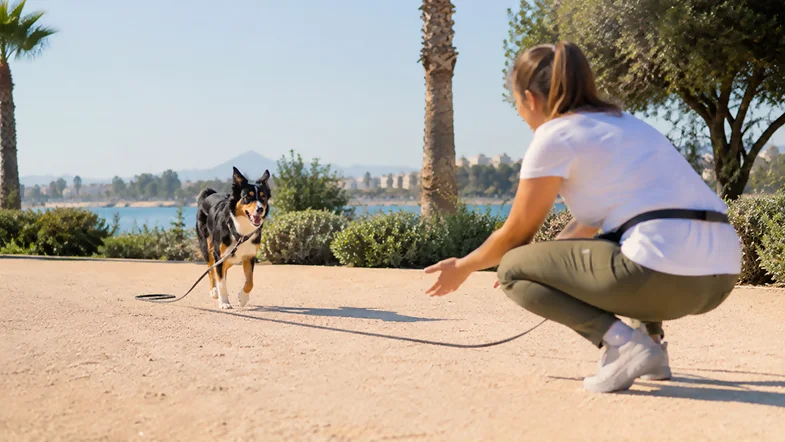
A dog that comes when called gives the family more safety, freedom and confidence. But recall is not built by shouting the dog’s name repeatedly. It requires motivation, history of reinforcement, gradual difficulty and good management.
At YunDog.es we work with real families and real dogs in everyday environments. The aim is not to create robotic obedience, but to improve calm, communication, management of the environment and useful behaviours that make life easier.
If you live in San Javier, Mar Menor, San Pedro del Pinatar, Los Alcázares, Santiago de la Ribera and surrounding areas, a professional assessment can help you understand what your dog is really showing and where to start safely.
Why does my dog not come when called?
Before trying to correct the behaviour, it is important to understand what is maintaining it. Similar behaviours can have very different causes depending on the dog, the family routine and the environment.
The environment is more rewarding
Smells, dogs, people and movement can be more interesting than the handler if recall has not been built properly.
The cue has been weakened
If “come” is repeated many times without result, the dog learns that the word is optional.
Coming back ends the fun
If recall always means lead on, leaving the park or stopping play, the dog may avoid it.
The dog is over threshold
A dog that is chasing, reacting or highly aroused may not be able to respond.
The training moved too fast
Recall must be built from easy situations to harder ones, not tested first in the most difficult environment.
Common signs to look for
- The dog ignores its name outside
- You repeat the cue several times
- The dog approaches but runs away again
- Recall fails around dogs or smells
- You only catch the dog when it is tired
- You no longer trust off-lead moments
These signs do not mean that your dog is “bad”. They are information. They tell us that the dog may need clearer guidance, better management, gradual exposure or a more specific behaviour plan.
Common mistakes that can make the problem worse
Calling when you cannot reinforce
Repeated failed recalls teach the dog not to respond.
Punishing when the dog finally returns
Even if the dog took too long, punishing return makes coming back less attractive.
Using recall only to end freedom
The dog should learn that coming back often leads to good things, not only restriction.
Allowing unsafe freedom too early
Freedom without recall can create risk and bad habits.
What you can start doing
The following guidelines are a starting point, not a substitute for a professional assessment. They can help you work with more clarity while avoiding the most common errors.
Start at home
Build a strong response in easy places before increasing distractions.
Pay well for coming back
Use food, play, praise and release back to sniffing when appropriate.
Use a long line
A long line allows safety while the dog learns.
Practise and release
Call the dog, reward, then let it go back to exploring so recall does not always end fun.
When to ask for professional help
Professional help is especially important when the behaviour is repeated, increasing, affecting daily life or linked to fear, aggression, strong stress, anxiety or loss of control.
- The dog runs towards roads, dogs or people
- Recall fails in most outdoor situations
- The dog has hunting or chasing behaviour
- You need more safety off lead
- You are unsure how to progress without risk
A good assessment helps identify whether the priority is education, management, emotional regulation, gradual exposure or a specific behaviour modification plan.
How YunDog.es can help
At YunDog.es we teach recall as useful obedience for real life, not as a trick.
The work includes motivation, long-line handling, distraction levels, release cues, safe criteria and practical exercises for the places where you actually walk.
We work in real contexts: home routines, streets, walks, local areas, controlled exposure and practical exercises that the family can repeat with clear criteria.
Tell us what is happening with your dog and we will assess the best starting point.
Frequently asked questions
How long does recall take?
It depends on the dog, history and distractions. A reliable recall is built progressively.
Should I use the dog’s name as recall?
The name should get attention. A specific recall cue can be clearer.
Can older dogs learn recall?
Yes, but safety and reinforcement history are important, especially if the dog has practised ignoring the cue.
Need help with your dog?
If this situation is affecting your walks, your home life or your confidence with your dog, you do not need to keep trying random advice. A clear assessment can save time and prevent the problem from becoming more established.
At YunDog.es we can help you understand what your dog needs and build a realistic plan for better everyday life.
J. Blesa, dog trainer and behaviour modification specialist
Need help with your dog?
If your dog pulls on the lead, barks, reacts to other dogs, struggles at home or you do not know how to manage the situation, tell us about your case.
Contact YunDog