
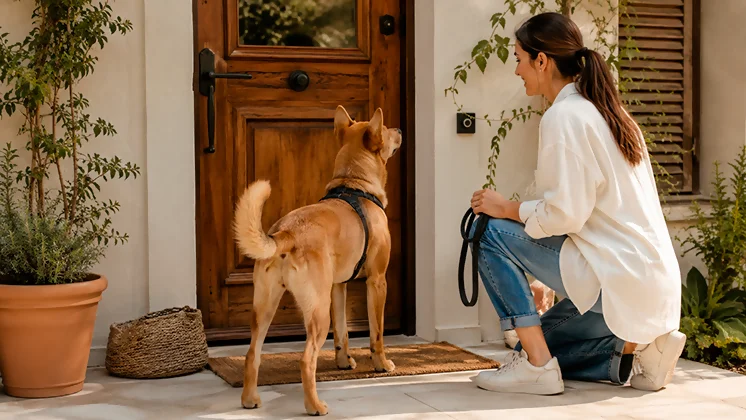
Some dogs do not start pulling in the street; they start losing control the moment the lead appears. Jumping, barking, spinning, grabbing the lead or rushing through the door are signs that the walk begins with too much arousal.
At YunDog.es we work with real families and real dogs in everyday environments. The aim is not to create robotic obedience, but to improve calm, communication, management of the environment and useful behaviours that make life easier.
If you live in San Javier, Mar Menor, San Pedro del Pinatar, Los Alcázares, Santiago de la Ribera and surrounding areas, a professional assessment can help you understand what your dog is really showing and where to start safely.
Why does the dog get so excited before going out?
Before trying to correct the behaviour, it is important to understand what is maintaining it. Similar behaviours can have very different causes depending on the dog, the family routine and the environment.
Departure cues predict excitement
Lead, harness, shoes and keys can become triggers for a huge emotional response.
The routine is too fast
If everything happens quickly, the dog has no chance to regulate before leaving.
The dog has rehearsed the pattern
Every day the same sequence can strengthen jumping, barking and rushing.
The walk is the main outlet
If the dog has little calm activity or structure, the walk may carry too much emotional weight.
There may be anxiety or frustration
Some dogs are not just happy; they are unable to manage anticipation.
Common signs to look for
- Barking when the lead appears
- Jumping or mouthing clothes
- Pulling towards the door
- Ignoring known cues before leaving
- Rushing out without waiting
- Starting the walk already pulling
These signs do not mean that your dog is “bad”. They are information. They tell us that the dog may need clearer guidance, better management, gradual exposure or a more specific behaviour plan.
Common mistakes that can make the problem worse
Opening the door while the dog is frantic
This rewards the emotional explosion with access to the walk.
Repeating cues endlessly
If the dog cannot respond, repeating “sit” or “wait” only weakens the cue.
Getting angry before the walk
Tension from the handler can add more arousal.
Thinking the problem starts outside
For many dogs, the real work begins indoors.
What you can start doing
The following guidelines are a starting point, not a substitute for a professional assessment. They can help you work with more clarity while avoiding the most common errors.
Desensitise the lead and harness
Pick them up, move them, put them down and sometimes do not go out, so they stop predicting immediate excitement.
Slow the sequence down
Put pauses between each step: harness, lead, door, waiting and exit.
Reward calm moments
Look for small moments of stillness, breathing, attention or waiting.
Use a clear release cue
The dog should learn when movement starts, instead of deciding by rushing.
When to ask for professional help
Professional help is especially important when the behaviour is repeated, increasing, affecting daily life or linked to fear, aggression, strong stress, anxiety or loss of control.
- The dog cannot calm before any walk
- There is barking, biting or strong frustration
- The dog launches through doors dangerously
- Walks are stressful from the first second
- You cannot create calm despite trying
A good assessment helps identify whether the priority is education, management, emotional regulation, gradual exposure or a specific behaviour modification plan.
How YunDog.es can help
At YunDog.es we work the whole walking routine, from preparation at home to the first minutes outside.
We teach families how to lower arousal, use clear signals, reinforce calm and build a predictable structure before the dog reaches the street.
We work in real contexts: home routines, streets, walks, local areas, controlled exposure and practical exercises that the family can repeat with clear criteria.
Tell us what is happening with your dog and we will assess the best starting point.
Frequently asked questions
Should I wait until the dog is completely calm?
The goal is not perfection, but a level of arousal the dog can manage. This is trained gradually.
Can I still walk if the dog is excited?
Yes, but if every exit starts in chaos, the pattern is reinforced. Training sessions should be planned.
Does this affect lead pulling?
Very often. A dog that leaves overexcited is more likely to pull outside.
Need help with your dog?
If this situation is affecting your walks, your home life or your confidence with your dog, you do not need to keep trying random advice. A clear assessment can save time and prevent the problem from becoming more established.
At YunDog.es we can help you understand what your dog needs and build a realistic plan for better everyday life.
J. Blesa, dog trainer and behaviour modification specialist
Need help with your dog?
If your dog pulls on the lead, barks, reacts to other dogs, struggles at home or you do not know how to manage the situation, tell us about your case.
Contact YunDog