
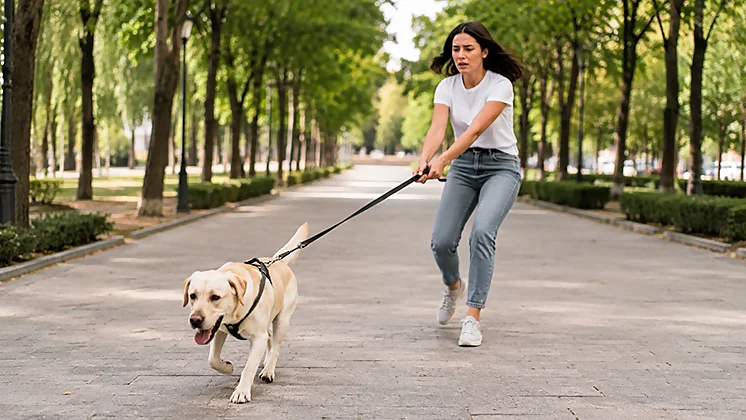
If your dog pulls on the lead, walks ahead, zigzags across the pavement or turns every outing into a physical struggle, the walk stops being enjoyable. This is one of the most common problems in everyday dog ownership, and it usually has more to do with arousal, habits, environment and communication than with stubbornness.
At YunDog.es we work with real families and real dogs in everyday environments. The aim is not to create robotic obedience, but to improve calm, communication, management of the environment and useful behaviours that make life easier.
If you live in San Javier, Mar Menor, San Pedro del Pinatar, Los Alcázares, Santiago de la Ribera and surrounding areas, a professional assessment can help you understand what your dog is really showing and where to start safely.
Why does my dog pull on the lead?
Before trying to correct the behaviour, it is important to understand what is maintaining it. Similar behaviours can have very different causes depending on the dog, the family routine and the environment.
High arousal before leaving home
Many dogs start the walk already overexcited when they see the lead, harness or keys. If the dog leaves the house in that emotional state, calm walking is much harder.
Pulling has been reinforced
If pulling makes the dog reach smells, dogs, people or interesting places, the behaviour works. A dog repeats what gets results.
The dog does not understand the walking rules
Dogs need to learn when they are allowed to sniff, when to walk close, when to stop and how to respond to direction changes. Without clear signals, the lead becomes constant tension.
The environment is too difficult
Dogs, traffic, bicycles, cafés, children and new smells can raise arousal quickly. In busy local areas around the Mar Menor, some dogs need gradual work before they can cope.
Fear, insecurity or reactivity
Some dogs pull because they want distance from something, not because they want to move forward. If there is barking, lunging, freezing or intense body tension, assessment is important.
Common signs to look for
- The lead is tight for most of the walk
- The dog cannot respond to its name outside
- The dog rushes towards smells, dogs or people
- You avoid certain routes because the walk is stressful
- Your arm or shoulder hurts after walks
- The dog only walks calmly when exhausted
These signs do not mean that your dog is “bad”. They are information. They tell us that the dog may need clearer guidance, better management, gradual exposure or a more specific behaviour plan.
Common mistakes that can make the problem worse
Correcting only with lead jerks
Lead jerks may interrupt the dog, but they rarely teach calm walking. They can also increase tension or negative associations in sensitive dogs.
Changing equipment without changing learning
A better harness or lead can improve safety, but equipment alone does not teach the dog how to walk.
Trying to tire the dog out
More exercise can sometimes create more stamina and more arousal. The goal is not only tiredness; it is self-regulation and communication.
Starting in the hardest environment
Training loose lead walking in a busy street before the dog understands the basics often creates frustration.
What you can start doing
The following guidelines are a starting point, not a substitute for a professional assessment. They can help you work with more clarity while avoiding the most common errors.
Start before the door opens
Practise calm routines with the harness, lead and doorway. A calmer start usually gives you a better walk.
Reward lead slack
Do not only react when the dog pulls. Mark and reward moments when the lead is loose, the dog checks in or slows down.
Use clear direction changes
A calm change of direction can help the dog reconnect, especially before the lead becomes fully tense.
Separate working time and sniffing time
Use clear signals for guided walking and controlled freedom. Dogs need both structure and exploration.
When to ask for professional help
Professional help is especially important when the behaviour is repeated, increasing, affecting daily life or linked to fear, aggression, strong stress, anxiety or loss of control.
- The pulling is daily and strong
- There is barking, lunging or freezing on walks
- You cannot recover the dog’s attention outside
- The dog reacts to other dogs, traffic or people
- You feel unable to manage the walk safely
A good assessment helps identify whether the priority is education, management, emotional regulation, gradual exposure or a specific behaviour modification plan.
How YunDog.es can help
At YunDog.es we assess the whole walk: the start at home, lead handling, arousal, motivation, environment and the dog’s ability to respond to useful signals.
The plan may include loose lead work, calm transitions, direction changes, attention exercises, controlled sniffing and gradual exposure to real-life distractions.
We work in real contexts: home routines, streets, walks, local areas, controlled exposure and practical exercises that the family can repeat with clear criteria.
Tell us what is happening with your dog and we will assess the best starting point.
Frequently asked questions
Should my dog walk at heel all the time?
No. A healthy walk includes guided sections and sniffing sections. The goal is a dog that can walk without constant tension and respond when needed.
Is a harness better than a collar?
It depends on the dog and the case. Equipment can help with safety, but training and management are what change the behaviour.
Can an adult dog learn not to pull?
Yes. Adult dogs can learn new walking habits, although long-established patterns need consistency and clear criteria.
Need help with your dog?
If this situation is affecting your walks, your home life or your confidence with your dog, you do not need to keep trying random advice. A clear assessment can save time and prevent the problem from becoming more established.
At YunDog.es we can help you understand what your dog needs and build a realistic plan for better everyday life.
J. Blesa, dog trainer and behaviour modification specialist
Need help with your dog?
If your dog pulls on the lead, barks, reacts to other dogs, struggles at home or you do not know how to manage the situation, tell us about your case.
Contact YunDog