
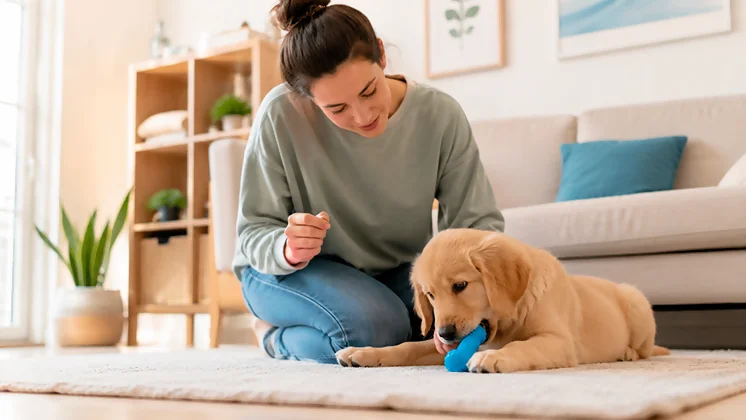
Puppies bite. They explore, play, communicate, relieve discomfort and test their body with their mouth. The problem appears when the biting becomes too intense, constant, painful or difficult for the family to manage.
At YunDog.es we work with real families and real dogs in everyday environments. The aim is not to create robotic obedience, but to improve calm, communication, management of the environment and useful behaviours that make life easier.
If you live in San Javier, Mar Menor, San Pedro del Pinatar, Los Alcázares, Santiago de la Ribera and surrounding areas, a professional assessment can help you understand what your dog is really showing and where to start safely.
Why does my puppy bite so much?
Before trying to correct the behaviour, it is important to understand what is maintaining it. Similar behaviours can have very different causes depending on the dog, the family routine and the environment.
Normal exploration
The mouth is one of the puppy’s main ways to discover the world.
Overtiredness
Many puppies bite harder when they need rest but cannot settle.
Overexcitement during play
Fast hands, shouting, running and rough play can increase biting intensity.
Lack of alternatives
If the puppy has no suitable outlets, hands, trousers and furniture become the target.
Poor bite inhibition practice
Puppies need to learn how to control pressure and stop when play becomes too much.
Common signs to look for
- Biting hands, sleeves, ankles or hair
- Biting increases in the evening
- The puppy cannot calm down after play
- Children are becoming afraid of the puppy
- The family reacts differently every time
- Biting becomes harder when corrected
These signs do not mean that your dog is “bad”. They are information. They tell us that the dog may need clearer guidance, better management, gradual exposure or a more specific behaviour plan.
Common mistakes that can make the problem worse
Playing too roughly
Rough play teaches rough biting. Puppies need controlled games and clear endings.
Punishing without teaching alternatives
Corrections may increase frustration if the puppy still does not know what to do instead.
Letting the puppy become exhausted
An overtired puppy is not easier; often it is more frantic.
Inconsistent family rules
If one person allows biting and another gets angry, the puppy receives mixed information.
What you can start doing
The following guidelines are a starting point, not a substitute for a professional assessment. They can help you work with more clarity while avoiding the most common errors.
Redirect to appropriate items
Offer chews, toys and structured tug games with rules.
Create calm breaks
Use short, calm breaks before the puppy becomes frantic.
Reward soft behaviour
Notice gentle mouth, calm contact and settling, not only biting.
Manage children and visitors
Prevent uncontrolled excitement that the puppy cannot handle yet.
When to ask for professional help
Professional help is especially important when the behaviour is repeated, increasing, affecting daily life or linked to fear, aggression, strong stress, anxiety or loss of control.
- The puppy bites very hard and breaks skin
- Children are scared or avoiding the puppy
- The puppy cannot stop once aroused
- There is growling, guarding or intense frustration
- You feel the situation is getting worse
A good assessment helps identify whether the priority is education, management, emotional regulation, gradual exposure or a specific behaviour modification plan.
How YunDog.es can help
At YunDog.es we help families understand puppy biting, create routines, teach alternatives, protect rest and build early obedience without harsh methods.
The work is practical: what to do with hands, play, rest, children, visitors, walks and daily structure.
We work in real contexts: home routines, streets, walks, local areas, controlled exposure and practical exercises that the family can repeat with clear criteria.
Tell us what is happening with your dog and we will assess the best starting point.
Frequently asked questions
Is puppy biting normal?
Yes, but it must be guided. Normal does not mean ignoring it until it becomes a habit.
Will the puppy grow out of it?
Some improvement comes with age, but poor habits can remain if the family does not guide the behaviour.
Should I close the puppy’s mouth?
No. It is better to manage arousal, redirect and teach clear play rules.
Need help with your dog?
If this situation is affecting your walks, your home life or your confidence with your dog, you do not need to keep trying random advice. A clear assessment can save time and prevent the problem from becoming more established.
At YunDog.es we can help you understand what your dog needs and build a realistic plan for better everyday life.
J. Blesa, dog trainer and behaviour modification specialist
Need help with your dog?
If your dog pulls on the lead, barks, reacts to other dogs, struggles at home or you do not know how to manage the situation, tell us about your case.
Contact YunDog