
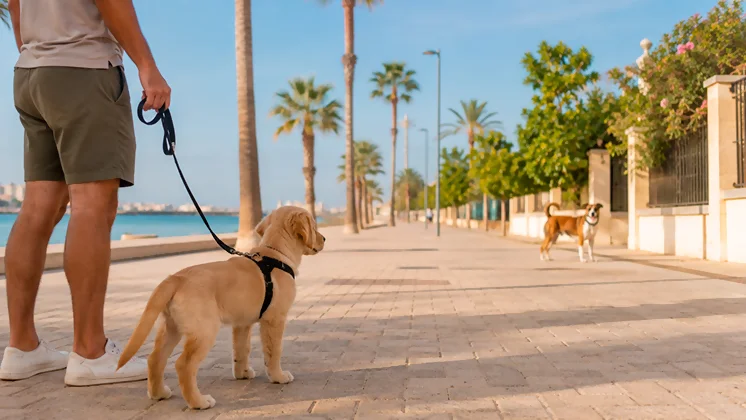
Puppy socialisation is one of the most important parts of early education, but it is often misunderstood. Socialising a puppy does not mean letting every dog, person or child approach. It means helping the puppy experience the world safely and progressively.
At YunDog.es we work with real families and real dogs in everyday environments. The aim is not to create robotic obedience, but to improve calm, communication, management of the environment and useful behaviours that make life easier.
If you live in San Javier, Mar Menor, San Pedro del Pinatar, Los Alcázares, Santiago de la Ribera and surrounding areas, a professional assessment can help you understand what your dog is really showing and where to start safely.
What is good puppy socialisation?
Before trying to correct the behaviour, it is important to understand what is maintaining it. Similar behaviours can have very different causes depending on the dog, the family routine and the environment.
Positive exposure
The puppy should experience people, dogs, noises, surfaces and places without being overwhelmed.
Observation without pressure
A puppy can learn a lot by watching from a safe distance. Contact is not always necessary.
Quality over quantity
One calm, safe experience is worth more than ten chaotic greetings.
Respecting the puppy’s signals
Hiding, freezing, yawning, trying to leave or refusing food can mean the situation is too much.
Building confidence gradually
Socialisation should create resilience, not force the puppy to cope with everything immediately.
Common signs to look for
- The puppy hides behind you
- The puppy is overwhelmed by dogs or people
- The puppy cannot recover after outings
- The puppy barks or freezes outside
- Everyone wants to touch the puppy
- Walks become too intense
These signs do not mean that your dog is “bad”. They are information. They tell us that the dog may need clearer guidance, better management, gradual exposure or a more specific behaviour plan.
Common mistakes that can make the problem worse
Letting all dogs greet
Uncontrolled dog greetings can scare a puppy or teach poor social habits.
Passing the puppy around
Too much handling by strangers can create stress instead of confidence.
Avoiding the world completely
Excessive isolation can make later exposure harder.
Confusing excitement with good socialisation
A puppy that is frantic is not necessarily learning well.
What you can start doing
The following guidelines are a starting point, not a substitute for a professional assessment. They can help you work with more clarity while avoiding the most common errors.
Plan short exposures
Choose safe places, short sessions and calm endings.
Use distance
Let the puppy see dogs, people and traffic from where it can still eat, sniff and recover.
Pair new things with good outcomes
Food, calm voice, space and choice can help the puppy feel safe.
Protect the puppy from bad experiences
You are allowed to say no to invasive dogs or people.
When to ask for professional help
Professional help is especially important when the behaviour is repeated, increasing, affecting daily life or linked to fear, aggression, strong stress, anxiety or loss of control.
- The puppy is very fearful outside
- The puppy reacts intensely to dogs or people
- You are unsure about vaccine-safe exposure
- There are children or other dogs at home
- You want to prevent future reactivity or fear
A good assessment helps identify whether the priority is education, management, emotional regulation, gradual exposure or a specific behaviour modification plan.
How YunDog.es can help
At YunDog.es we guide puppy socialisation with a realistic plan adapted to your environment, health stage and family routine.
The objective is a puppy that can see the world, recover well and build confidence without being forced.
We work in real contexts: home routines, streets, walks, local areas, controlled exposure and practical exercises that the family can repeat with clear criteria.
Tell us what is happening with your dog and we will assess the best starting point.
Frequently asked questions
Does my puppy need to meet many dogs?
No. The puppy needs good experiences around dogs, not random contact with every dog.
What if my puppy is scared?
Do not force. Increase distance, lower intensity and seek guidance if fear continues.
Can poor socialisation cause future problems?
It can contribute to fear, reactivity or insecurity, especially if exposure is too little or too intense.
Need help with your dog?
If this situation is affecting your walks, your home life or your confidence with your dog, you do not need to keep trying random advice. A clear assessment can save time and prevent the problem from becoming more established.
At YunDog.es we can help you understand what your dog needs and build a realistic plan for better everyday life.
J. Blesa, dog trainer and behaviour modification specialist
Need help with your dog?
If your dog pulls on the lead, barks, reacts to other dogs, struggles at home or you do not know how to manage the situation, tell us about your case.
Contact YunDog