
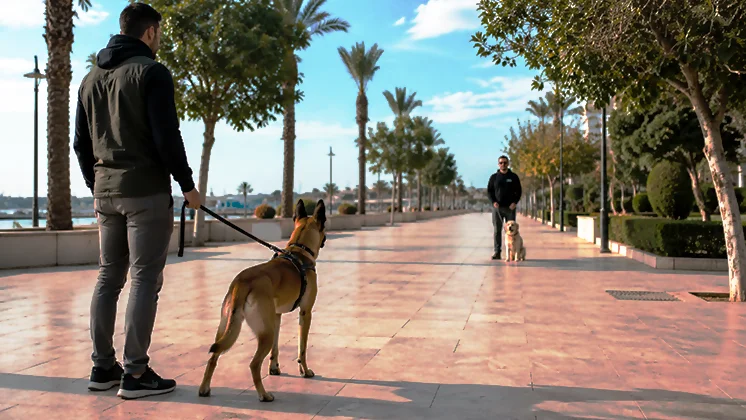
When a dog barks, lunges, stiffens, pulls or loses control when seeing another dog, the walk can become tense and unpredictable. Reactivity is not a label to judge the dog; it is a behaviour pattern that needs careful analysis, distance management and progressive work.
At YunDog.es we work with real families and real dogs in everyday environments. The aim is not to create robotic obedience, but to improve calm, communication, management of the environment and useful behaviours that make life easier.
If you live in San Javier, Mar Menor, San Pedro del Pinatar, Los Alcázares, Santiago de la Ribera and surrounding areas, a professional assessment can help you understand what your dog is really showing and where to start safely.
Why can a dog become reactive with other dogs?
Before trying to correct the behaviour, it is important to understand what is maintaining it. Similar behaviours can have very different causes depending on the dog, the family routine and the environment.
Fear or insecurity
Many reactive dogs are not trying to dominate other dogs. They may be asking for distance because they feel unsafe.
Frustration on lead
Some dogs want to approach, but the lead prevents it. That frustration can become barking, jumping, whining or lunging.
Poorly managed social experiences
Repeated intense greetings, invasive dogs or bad experiences can make a dog expect conflict or overload when seeing dogs.
High arousal and poor recovery
If the dog cannot return to calm after seeing another dog, each encounter builds more stress.
Reinforced reaction patterns
If barking makes the other dog move away, the dog may learn that reacting works. Over time, the reaction can start earlier and at a greater distance.
Common signs to look for
- Barking or lunging when seeing dogs
- Fixed stare, stiff body or raised tension
- Pulling strongly towards or away from dogs
- Difficulty taking food or responding to cues
- Long recovery time after the encounter
- Routes chosen only to avoid dogs
These signs do not mean that your dog is “bad”. They are information. They tell us that the dog may need clearer guidance, better management, gradual exposure or a more specific behaviour plan.
Common mistakes that can make the problem worse
Forcing greetings
Putting a reactive dog face to face with another dog to “get used to it” can be unsafe and can worsen the association.
Punishing the reaction without changing the emotion
Stopping the bark is not enough if the dog still feels unsafe, frustrated or overwhelmed.
Working too close
If the dog is already over threshold, learning quality is low. Distance is part of the treatment.
Letting everyone approach
Uncontrolled greetings remove the dog’s ability to feel safe and make consistent training impossible.
What you can start doing
The following guidelines are a starting point, not a substitute for a professional assessment. They can help you work with more clarity while avoiding the most common errors.
Identify the working distance
Find the distance where your dog notices another dog but can still think, eat and respond.
Use calm observation
Reward looking at the dog and then disengaging. The goal is not to ignore everything instantly, but to process the stimulus better.
Avoid rehearsal
Choose routes and distances that reduce repeated explosions while training begins.
Build recovery
After each exposure, help the dog return to calm before continuing.
When to ask for professional help
Professional help is especially important when the behaviour is repeated, increasing, affecting daily life or linked to fear, aggression, strong stress, anxiety or loss of control.
- Your dog barks or lunges at most dogs
- You are afraid the dog could bite
- The reaction distance is increasing
- The dog cannot calm down after encounters
- You have tried advice online and the problem persists
A good assessment helps identify whether the priority is education, management, emotional regulation, gradual exposure or a specific behaviour modification plan.
How YunDog.es can help
At YunDog.es we work reactivity through assessment, safety, threshold management, communication and gradual exposure.
We help families understand whether the behaviour is driven mainly by fear, frustration, lack of skills, previous experiences or a combination of factors.
We work in real contexts: home routines, streets, walks, local areas, controlled exposure and practical exercises that the family can repeat with clear criteria.
Tell us what is happening with your dog and we will assess the best starting point.
Frequently asked questions
Is a reactive dog aggressive?
Not always. Reactivity can come from fear, frustration, arousal or insecurity. Risk must still be assessed carefully.
Should my dog meet more dogs?
Not without criteria. More contact is not always better. Quality, distance and emotional state matter more.
Can reactivity improve?
Many dogs improve with a clear plan, safe management and progressive work. The pace depends on the individual case.
Need help with your dog?
If this situation is affecting your walks, your home life or your confidence with your dog, you do not need to keep trying random advice. A clear assessment can save time and prevent the problem from becoming more established.
At YunDog.es we can help you understand what your dog needs and build a realistic plan for better everyday life.
J. Blesa, dog trainer and behaviour modification specialist
Need help with your dog?
If your dog pulls on the lead, barks, reacts to other dogs, struggles at home or you do not know how to manage the situation, tell us about your case.
Contact YunDog