
1
Pulls from the start
Your dog leaves the door, stairs or street with constant tension on the lead.
If your dog always walks ahead, pulls strongly, ignores you outside or turns every walk into tension, we work on structure, lead handling, self-control and connection with the handler.
Tell us your situationLead pulling can have many causes: too much energy, lack of self-control, anxiety to move forward, poor walk structure, accidental reinforcement or unclear routines.
The goal is not for your dog to stay glued to your leg all the time, but to learn to walk calmly, pay attention to you and understand when to move forward, stop, wait or explore.
When the walk is unclear, many dogs end up taking control of the outing.
Your dog leaves the door, stairs or street with constant tension on the lead.
Ignores recall, rewards or signals because the environment is too exciting.
Rushes towards smells, dogs, people, corners or areas that catch their interest.
Whines, jumps, barks or becomes nervous when they cannot reach what they want.
Walks across your path, gets between your legs or makes the walk unsafe.
The family ends up tired, frustrated or avoiding certain routes.
We work on the walk as a clear sequence, not as a strength contest.
We observe the start, rhythm, tension, focus, lead handling and triggers.
Door routine, start of the walk, calm areas, sniffing time and focused walking sections.
Position, direction changes, stops, rhythm, lead tension and recovering focus.
We teach the dog to wait, avoid lunging forward and respond before reaching the trigger.
We reinforce checking in with the handler instead of moving forward without reference.
We train outdoors, with real distractions and goals adapted to your dog.
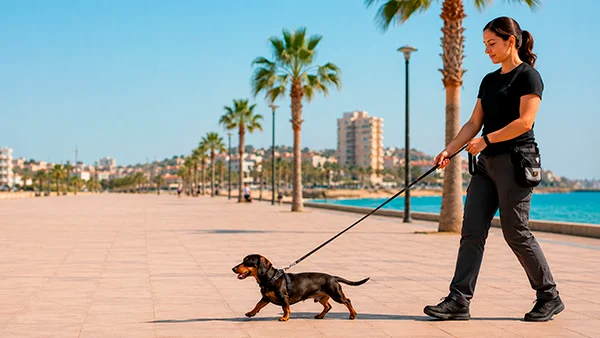
We aim for a more comfortable walk, with less tension, better communication and a structure your dog can understand.
If the pulling mainly happens when your dog sees other dogs, people, bikes or specific triggers, it may not only be a walking problem. It could also involve reactivity, frustration or insecurity.
In that case, it is important to assess the cause before focusing only on heelwork.
View reactive dog training →Ideal for teaching lead walking, practical obedience, self-control and everyday communication.
View dog training →Recommended if pulling is linked to reactivity, fear, frustration or anxiety.
View behaviour work →Useful when the dog can already work around other dogs and needs real-life distractions.
View group classes →