
1
Barking or crying when alone
Your dog vocalises during your absence or even before the family leaves.
If your dog cries, barks, destroys things, scratches doors, becomes stressed when you leave or cannot relax alone, we assess the case and work progressively to improve tolerance to separation.
Tell us your situationMany dogs that struggle when left alone are not trying to punish the family or behave badly. They may be experiencing stress, anxiety, frustration or a real difficulty coping with the absence of their people.
Before applying general advice, we need to understand what is really happening: when it starts, how long it lasts, what your dog does, how they settle, how they recover and what their routine looks like.
Not every dog shows the problem in the same way.
Your dog vocalises during your absence or even before the family leaves.
They may chew furniture, damage objects, scratch exits or try to escape.
Pacing, panting, watching the door or staying unsettled while alone.
Your dog becomes activated when they see keys, shoes, bags or specific leaving routines.
Some dogs urinate or defecate from stress even if they are usually clean.
When the family returns, the dog may be extremely excited, stressed or overwhelmed.
The work must be progressive, measured and adapted to the dog’s real capacity.
Schedules, walks, rest, departures, leaving cues and activation levels.
Videos help us see what your dog actually does when left alone.
We identify how long your dog can cope without entering intense stress.
We increase difficulty gradually, without repeatedly pushing the dog past their limit.
We work on leaving cues, routines and the moments before departure to lower activation.
We review progress and adapt the plan according to your dog’s real evolution.
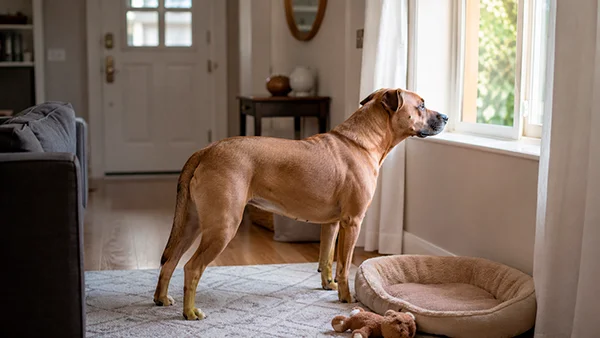
We help your dog learn to stay alone progressively, with less stress and a better ability to rest.
Not always. Sometimes the problem may be related to boredom, lack of rest, excess energy, poor structure, poor adaptation to the space or unclear routines.
That is why it is important to assess the case before labelling it. The solution changes a lot depending on the cause.
Recommended when there is anxiety, intense stress, destruction, vocalisation or inability to stay alone.
View behaviour modification →Very useful for reviewing videos, routines, progressive departures and follow-up from home.
View online advice →Can help when the problem is linked to routines, calmness, rest and daily structure.
View dog training →