
1
Food
Food bowl, treats, bones, chews, leftovers or any high-value food item.
If your dog growls, becomes tense, blocks access, shows teeth or tries to bite when someone approaches something they value, it is important to work safely and without forcing the situation.
Tell us your situationResource guarding appears when a dog feels they may lose something valuable: food, toys, a bed, rest, people, spaces or objects. If it is handled badly, it can escalate from simple tension to growling, warning snaps or bites.
The goal is to teach the dog that people approaching their resources is not a threat, but something predictable and safe.
It is not always food. Sometimes the resource is a space, a person or a specific situation.
Food bowl, treats, bones, chews, leftovers or any high-value food item.
Balls, chew toys, clothing, shoes, sticks or stolen items.
Sofa, bed, crate, resting area or elevated places.
Some dogs guard a family member from other people or animals.
Doors, rooms, garden, terrace, car or specific areas of the home.
It can appear when the dog wants to control who approaches or receives attention.
Before a bite, there are often warning signals. Detecting them helps prevent conflict.
The dog freezes when someone approaches the resource.
The dog speeds up eating or hunches over the resource.
The dog watches with tension, turns the head or gives a hard look.
A growl is a warning and should not be punished without understanding the cause.
The dog is setting a clear boundary before escalating further.
If your dog has already snapped or bitten, the case should be assessed as soon as possible.
The priority is to reduce conflict, avoid risk and change the dog’s emotional response.
We analyse what the dog guards, intensity, bite history, warning signs and family context.
We organise spaces, routines and resources to prevent conflict while we work.
This is not about taking things by force, challenging the dog or provoking reactions.
We teach the dog that releasing an item or allowing approach can lead to positive outcomes.
We work gradually and safely on people being near the resource.
Everyone at home must know how to act to avoid increasing tension or risk.
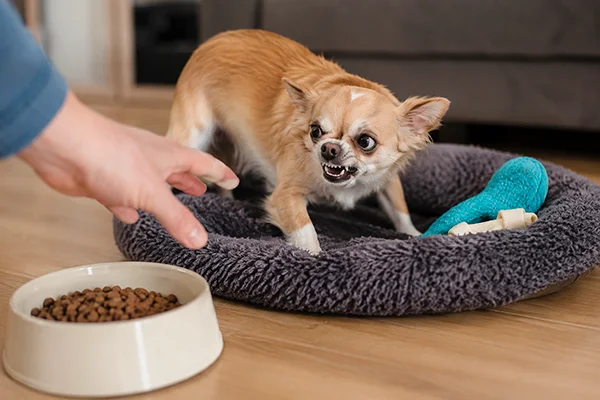
We work to reduce tension, prevent conflict and teach your dog safer responses around valued resources.
If there are children at home, frequent visitors, other animals or the dog has already snapped or bitten, it is important to act preventively and assess the case as soon as possible.
Resource guarding should not be worked on by provoking the dog. Safety and environmental management are the foundation of the process.
The main option when there is growling, tension, threats, snapping or biting.
View behaviour work →Can help guide safety measures, environmental management and first steps.
View online consultation →Useful when the dog needs better rules, exchanges, release cues, calmness and daily structure.
View dog training →