
1
Avoids or hides
Moves away, backs up, hides behind the handler or tries to escape the trigger.
If your dog freezes, runs away, avoids people, dogs, noises or new environments, we work on safety, confidence and coping skills in a progressive way.
Tell us your situationA fearful dog needs to feel safe before they can learn. Forcing approaches, exposing them too quickly or ignoring their signals can make the problem worse.
The goal is to help your dog build confidence, understand which situations are too much for them and learn to manage the environment with more calm and security.
Some dogs show fear clearly; others express it through more subtle signals.
Moves away, backs up, hides behind the handler or tries to escape the trigger.
Stops moving, becomes stuck, does not respond or seems unable to move forward.
Some dogs react to increase distance when they feel unsafe or threatened.
Stays glued to the handler, does not sniff or is afraid to investigate the environment.
Noises, movement, objects, people or dogs trigger exaggerated responses.
After being startled, your dog remains nervous, alert or unable to relax.
We work from safety, the right distance and progressive exposure.
We analyse what scares your dog, since when, intensity, context and background.
We find the point where the dog can observe without freezing or reacting.
We remove unnecessary exposure and avoid situations that overwhelm the dog.
We use routines, clear references, reinforcement and controlled experiences.
We increase difficulty gradually, without forcing or exceeding the dog’s capacity.
We help the dog explore, make choices and recover calm more easily.
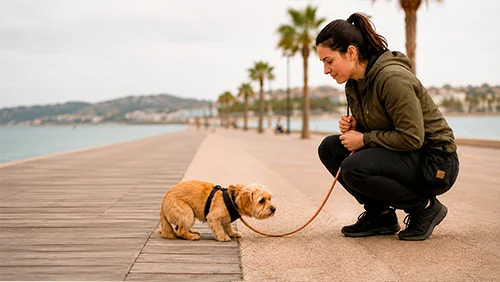
We help your dog build confidence without forcing, using progressive experiences adapted to their real capacity.
Some fearful dogs bark, growl or lunge to move the scary thing away. In those cases it may look like aggression, but the root is often insecurity or fear.
That is why it is important to assess the case before labelling the dog or forcing them to face what scares them.
View reactive dog training →The main option for fear, insecurity, fear-based reactivity or stress-related issues.
View behaviour work →Can help review videos, routines, handling and first steps from home.
View online consultation →Useful when the dog needs structure, basic obedience and clear routines.
View dog training →