
1
Barking or growling
Intense barking, growling or vocalising when another dog appears.
If your dog barks, lunges, pulls, freezes or fixates when seeing other dogs, we work on the root of the problem with distance, handling, self-control and progressive exposure.
Tell us your situationWhen a dog reacts to other dogs, there is usually a strong emotion behind it: fear, insecurity, frustration, overexcitement, previous bad experiences or poor coping skills.
The goal is not to force the dog to “be quiet”, but to teach them how to manage the presence of other dogs in a calmer, safer and more controlled way.
Reactivity can appear in different ways. Not every dog reacts the same.
Intense barking, growling or vocalising when another dog appears.
The dog pushes forward, becomes stiff or pulls the handler strongly.
Your dog stares intensely at the other dog and loses the ability to focus on you.
Your dog stops moving, becomes stuck, does not respond or seems unable to walk away.
Your dog wants to approach, cannot do it, and the tension turns into barking or pulling.
After seeing another dog, your dog stays nervous, alert or continues looking for more triggers.
The key is working below threshold, safely and with realistic progression.
We analyse intensity, critical distance, history, handling, routine and triggers.
We find the distance where your dog can see the trigger without exploding.
Lead handling, direction changes, stops, orientation and moving away from triggers.
We help change the emotional response associated with seeing other dogs.
We teach alternatives: looking at the handler, changing direction, waiting and recovering calm.
We increase difficulty gradually, without forcing encounters the dog cannot manage.
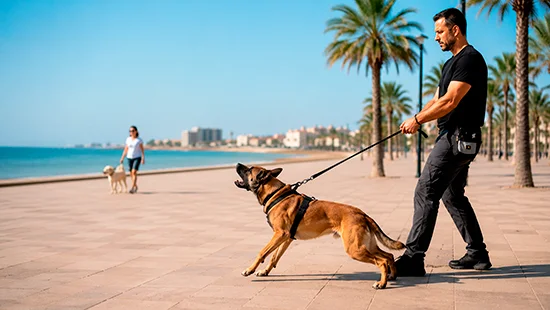
We help your dog learn to see other dogs without automatically going into barking, tension or loss of control.
If your dog has already bitten, tries to bite, lunges with strong force or you cannot control them safely, the case must be assessed before exposing them to other dogs.
In some cases, working with a properly conditioned muzzle and specific safety measures may be recommended.
The main option for working on reactivity, distance, handling and progressive exposure.
View behaviour modification →Useful when the dog can already work near other dogs without becoming overwhelmed.
View group classes →Can help review handling, videos, routine and first steps from home.
View online advice →